
In the hyper-competitive landscape of 2026, the difference between a startup that scales and one that stalls often comes down to its digital marketing stack. With thousands of SaaS solutions vying for your attention, the challenge is no longer finding a tool—it is finding the right tool that delivers measurable ROI without burning through your limited runway.
As a founder or marketing lead, you are likely balancing the need for sophisticated automation with the reality of a tight budget. Building a powerful marketing toolkit is about more than just grabbing the latest “shiny object”; it is about creating a cohesive ecosystem that streamlines your efforts, maximizes your reach, and fuels long-term growth.
The Strategic Framework: How to Evaluate Your Needs
Before diving into software trials, you must define your operational maturity. Selecting the best digital marketing tools for startups requires a disciplined approach to avoid “feature creep” and subscription bloat.
1. Identify Your Core Growth Lever
Are you struggling with lead generation, brand awareness, or customer retention? A B2B SaaS startup will have vastly different needs than an e-commerce brand. For instance, if your growth is driven by content, prioritize SEO and CMS platforms over complex paid-media management suites.
2. The “Scalability vs. Simplicity” Trade-off
Startups often make the mistake of choosing “enterprise-grade” tools too early. While these platforms offer endless features, they often come with steep learning curves and high costs. In 2026, the best tools are those that offer modular pricing, allowing you to start small and unlock advanced features only as your revenue grows.
3. Integration Capabilities
A tool is only as good as its ability to talk to your existing tech stack. Whether you use a CRM like HubSpot or a data warehouse like Snowflake, ensure your chosen marketing tools offer native integrations or robust API support. Siloed data is the primary killer of effective marketing campaigns.
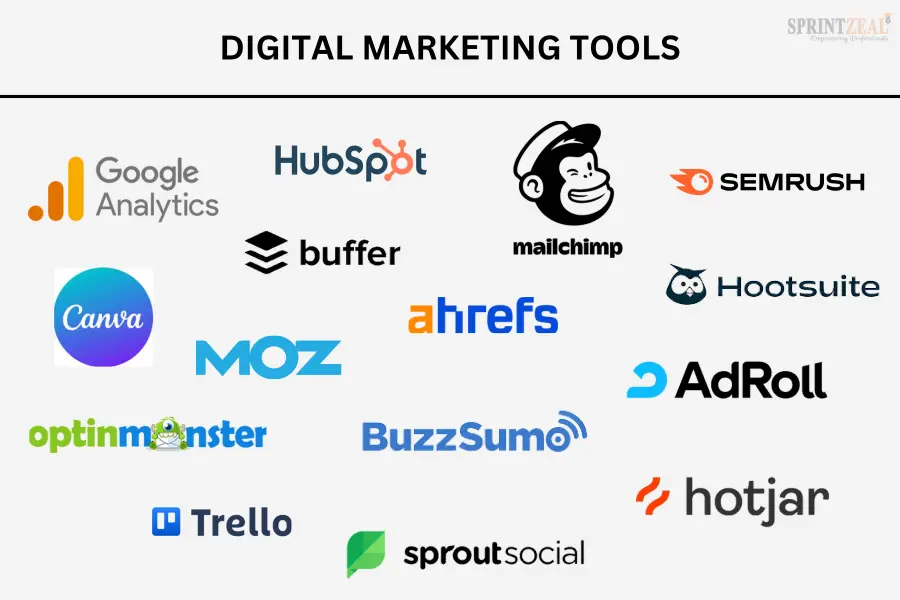
Essential Categories for Your 2026 Marketing Stack
To build a high-performance engine, your toolkit should cover these five critical pillars. Each category represents a vital stage in the customer journey.
Customer Relationship Management (CRM)
Your CRM is the heart of your startup. It acts as the single source of truth for all customer interactions. In 2026, look for CRMs that leverage predictive AI to score leads, helping your sales team focus on prospects who are most likely to convert.
Search Engine Optimization (SEO) & Content Strategy
Content remains the most sustainable driver of organic traffic. Tools that utilize AI-driven keyword research and content optimization are essential. They help you stay ahead of changing search engine algorithms by ensuring your content provides genuine value to the user.
Social Media & Community Management
Social media is no longer just about posting; it is about community building. The most effective tools today allow you to monitor brand sentiment across multiple channels in real-time. This is crucial for startups that need to pivot their messaging based on immediate market feedback.
Email Marketing & Automation
Despite the rise of new platforms, email remains the channel with the highest ROI. Look for automation platforms that allow for behavior-based segmentation. Triggering an email based on a specific action—like visiting a pricing page—is significantly more effective than generic newsletters.
Analytics and Data Visualization
You cannot improve what you do not measure. In 2026, privacy regulations are stricter than ever. Choose analytics tools that offer cookieless tracking and provide clear, actionable insights rather than just raw data dumps.
![Top 30 Best Digital Marketing Tools In 2026 [For Beginners, Small Businesses, Startups]](https://findtoselect.com/wp-content/uploads/2026/05/Top-30-Best-Digital-Marketing-Tools-1-614x1536-1.png)
The Cost-Effectiveness Factor: Finding Value in 2026
For many startups, budget is the ultimate constraint. However, “cheap” can often be expensive in terms of time lost. Here is how to balance your budget while selecting the best software:
Audit for Overlap: Many tools have overlapping features. If your email platform has a basic landing page builder, you might not need a separate, expensive landing page software.
Leverage Freemium Tiers: Many industry-leading tools offer generous free tiers. Use these to test your workflows before committing to a paid plan.
Calculate the “Time-to-Value”: If a tool costs $50/month but saves your team 10 hours of manual work, the return on investment is clear. Always value your team’s time as a core cost.
Negotiate Annual Plans: Most software providers offer 15-25% discounts for annual commitments. If you have vetted the tool and are confident in its utility, this is an easy way to lower your burn rate.
Avoiding Common Pitfalls in Tool Selection
Even with the best intentions, startups often fall into traps that hinder their growth. Here is how to stay on track:
Falling for the “Feature Trap”
Do not be swayed by a tool that offers 100 features if you only need two. Complex software often leads to lower adoption rates among staff. Simple, focused tools are almost always better for early-stage startups because they ensure high usage and consistent data entry.
Ignoring the Learning Curve
If a tool requires a dedicated specialist to operate, it might not be the right fit for your lean team. Look for platforms with intuitive UIs and excellent customer support resources. A tool that is difficult to use is one that will eventually be abandoned.
Neglecting Data Ownership
Always ensure you can export your data easily. If you ever decide to switch platforms, you should not be held hostage by a proprietary system that makes it impossible to migrate your contacts, history, or campaign data.
The Future of Marketing: AI-Driven Efficiency
As we move further into 2026, AI is no longer a luxury; it is a standard component of every top-tier marketing tool. When selecting your stack, prioritize tools that integrate Generative AI for copywriting, Predictive Analytics for forecasting, and Automated Personalization for customer interactions.
These AI features allow you to scale your marketing efforts without scaling your headcount linearly. By automating the repetitive, manual tasks, you free up your team to focus on the high-level strategy and creative work that truly differentiates your startup in the marketplace.
Conclusion: Building Your Foundation for Growth
Finding and selecting the best digital marketing tools for startups is an ongoing process of experimentation and refinement. Your stack in 2026 should be agile, integrated, and deeply aligned with your specific business goals.
Start by auditing your current pain points, prioritize tools that offer clear value and scalability, and always keep an eye on how these tools work together to create a seamless customer experience. Remember, the best marketing tool is the one that empowers your team to execute faster, smarter, and more effectively.
By investing the time to select the right software today, you are laying the foundation for a scalable, data-driven, and highly successful future. Choose wisely, integrate carefully, and watch your startup reach new heights.